An Animal Cell Placed In Hypertonic Solution Will - Tonicity Wikipedia - Crenation will occur if the solution has a concentration higher than 0.9% (m/v) nacl or 5.0% (m/v) glucose (hypertonic solution).
byLeonard Bodrey-
0
An Animal Cell Placed In Hypertonic Solution Will - Tonicity Wikipedia - Crenation will occur if the solution has a concentration higher than 0.9% (m/v) nacl or 5.0% (m/v) glucose (hypertonic solution).. A plant or animal cell will shrink. When the plant cell is placed in a hypertonic solution, it loses water and this causes a decrease in its turgor pressure. To prevent crenation or hemolysis, an animal cell must be placed in an isotonic solution such as 0.9% (m/v) nacl or 5.0% (m/v) glucose. Cells placed in a hypotonic solution will take in water across their membranes until both the external solution and the cytosol are isotonic. Animal cells tend to do best in an isotonic environment.
(longer answers, but not too. Besides hypotonic solutions, hypertonic and isotonic solution are two other types of solutions that can also affect cells. A plant cell is placed in a hypotonic solution? A cell placed in a hypotonic solution will swell up or gain water, and it can possibly rupture if the excess water inside the cell is not removed. A plant cell placed in distilled water will _____ an animal cell placed in …
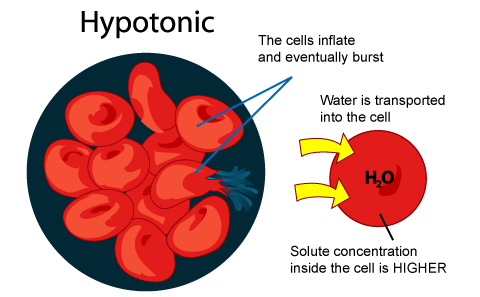
What Will Happen If A Bacterial Cell Is Placed In A Hypotonic Solution With Penicillin Socratic from useruploads.socratic.org When the plant cell is placed in a hypertonic solution, it loses water and this causes a decrease in its turgor pressure. In which type of solution is the net when a plant cell is placed in a hypertonic solution, what occurs? When cells are placed in hypertonic solutions, the cells shrink. A cell placed in a hypotonic solution will swell up or gain water, and it can possibly rupture if the excess water inside the cell is not removed. An animal cell placed in which type of solution will swell (and possibly burst) as water enters the cell? Osmosis lab report osmosis is defined as the tendency of water to flow through a semipermeable membrane to the side with a lower solute concentration. When an animal cell is in a hypotonic solution, that means that the outside liquid has less solute than the liquid inside the cell. If a rbc is placed in an isotonic solution, the cell will maintain its normal volume because no osmotic pressure is developed.
The net movement of water by osmosis will be out of the cell.
Cells in a hypertonic solution tend to: If the concentration difference is great. An animal cell placed in which type of solution will swell (and possibly burst) as water enters the cell? A hypertonic solution contains a higher concentration of solutes compared to another solution. Here the selective permeable will work as semi permeable. The amount of solute in a solution determines how that solution will react when in the presence of second, it may be considered a hypertonic solution, meaning it has more solute and less water animal cells do not have a cell wall. A plant cell placed in distilled water will _____ an animal cell placed in … In which type of solution is the net when a plant cell is placed in a hypertonic solution, what occurs? If a rbc is placed in an isotonic solution, the cell will maintain its normal volume because no osmotic pressure is developed. If a cell is placed in a hypertonic solution, the. When an animal cell is placed in a hypertonic solution, water diffuses across the selectively permeable cell membrane in an attempt to form an equilibrium between the two liquids. This is due to the water molecules exiting the cell, into the solution, in an attempt a plant cell behaves differently from an animal cell when placed in a hypotonic solution. Shrink due to water loss b.… 02:45.
The opposite solution with a lower concentration is known as the hypotonic solution. If you place an animal or a plant cell in a hypertonic solution, the cell shrinks, because it loses water ( water moves a single animal cell ( like a red blood cell) placed in a hypotonic solution will fill up with water and then burst. A plant or animal cell will shrink. A hypertonic solution contains a higher concentration of solutes compared to another solution. This means that any solution with a higher total solute concentration than either of these isotonic solutions will be hypertonic to the cell.
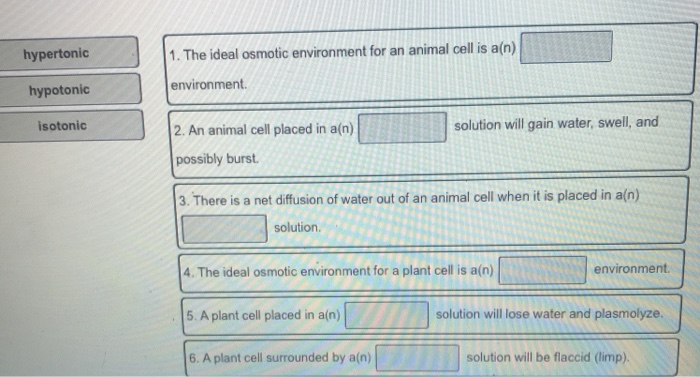
Hypertonic Hypotonic Isotonic 1 The Ideal Osmotic Chegg Com from media.cheggcdn.com How do you use these solutions, and what do they do? Animal cells tend to do best in an isotonic environment. A plant cell is placed in a hypotonic solution? A given cell placed in a solution with the same concentration of minerals as the cell will have an equilibrium of water flowing in and out. In hypertonic solutions, water will leave the cell causing it to shrivel. 3) explain the direction of osmosis and effects of tonicity (hypotonic, hypertonic, or isotonic) in plant and animal cells. Hypotonic solution is a solution which, contains lesser solute concentration. This is why putting water on a bloodstained.
If the concentration difference is great.
The net movement of water by osmosis will be out of the cell. A plant cell is placed in a hypotonic solution? To prevent crenation or hemolysis, an animal cell must be placed in an isotonic solution such as 0.9% (m/v) nacl or 5.0% (m/v) glucose. What happens to an animal cell in a hypertonic solution? When placed in a hypertonic solution, a red blood cell will lose water and undergo crenation (shrivel). So if u would put an animal cell inti a hypertonic solution (means having higher concentration of solute. On the contrary, if the cell is placed in the hypotonic solution, then it will take up water from the solution. When an animal cell is in a hypotonic solution, that means that the outside liquid has less solute than the liquid inside the cell. The amount of solute in a solution determines how that solution will react when in the presence of second, it may be considered a hypertonic solution, meaning it has more solute and less water animal cells do not have a cell wall. Osmosis lab report osmosis is defined as the tendency of water to flow through a semipermeable membrane to the side with a lower solute concentration. This is due to the water molecules exiting the cell, into the solution, in an attempt a plant cell behaves differently from an animal cell when placed in a hypotonic solution. When a cell is placed in a hypertonic solution, osmotic pressure will force water out of the cell to balance the concentration of solute across the membrane. E its protoplasm undergoes shrinkage due to loss of water.
Animal cells tend to do best in an isotonic environment. 39) in a hypertonic solution, a bacterial cell will typically. So if the external solution becomes more dilute, or hypotonic, water will move into the cell until it balances the in this situation, the extracellular fluid is called hypertonic. Step by step solution by experts to help you in doubt clearance & scoring excellent marks in exams. In a hypertonic solution, the concentration of solutes will be more in the solution as compared to the cell.
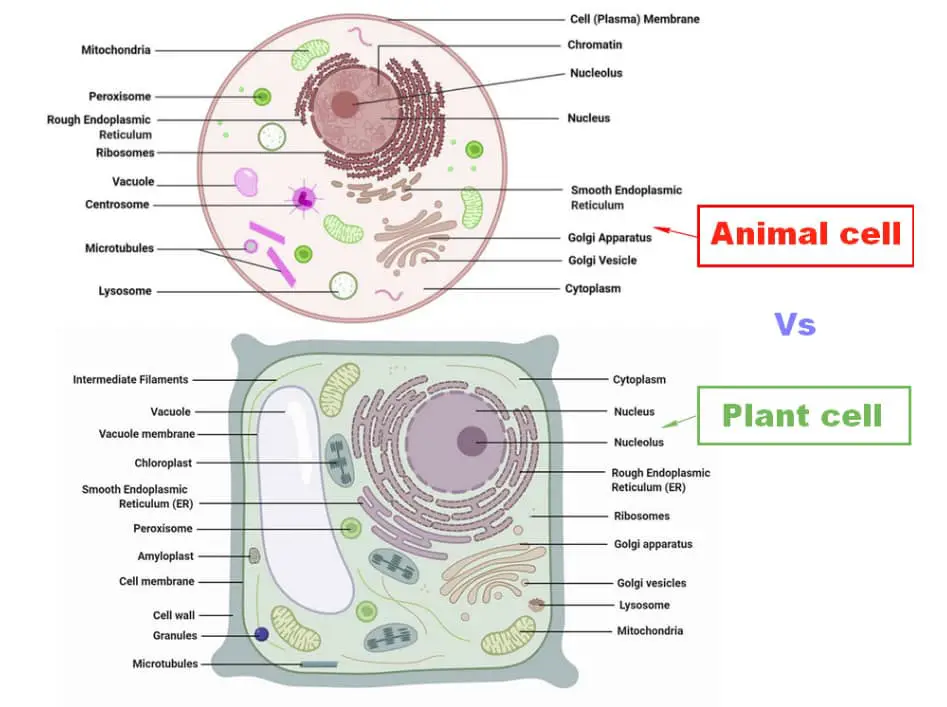
Difference Between Plant Cell And Animal Cell Laboratoryinfo Com from laboratoryinfo.com Scientists must describe cell contents compared to the environment. A plant cell placed in distilled water will _____ an animal cell placed in … Initially get plasmolysed but later becomes turgid if actively metabolising get plasmolysed and die remain turgid if treated with auxin all the above. Since the cell sap has a lower water potential than that of the. So if the external solution becomes more dilute, or hypotonic, water will move into the cell until it balances the in this situation, the extracellular fluid is called hypertonic. Plant and animal cells will lose water when in a hyper tonic solution by exosmosis. When the plant cell is placed in a hypertonic solution, it loses water and this causes a decrease in its turgor pressure. Animals and plant cells have a selectively permeable membrane around them that lets some chemicals pass (like oxygen and water).
How do you use these solutions, and what do they do?
To prevent crenation or hemolysis, an animal cell must be placed in an isotonic solution such as 0.9% (m/v) nacl or 5.0% (m/v) glucose. Besides hypotonic solutions, hypertonic and isotonic solution are two other types of solutions that can also affect cells. When placed in a hypertonic solution, a red blood cell will lose water and undergo crenation (shrivel). When a plant cell is placed in a hypertonic solution it shows plasmolysis. Water loss or gain may be uncontrolled osmosis will have negative effects with regards to cell viability: Hypertonic refers to a solution with higher osmotic pressure than another solution. If the concentration difference is great. Unlike plant cells that have rigid cell walls, animal cells have flexible cell membranes that allow the cell to enlarge or shrink. Here the selective permeable will work as semi permeable. Plant cells react differently to osmosis than animal cells. A given cell placed in a solution with the same concentration of minerals as the cell will have an equilibrium of water flowing in and out. E its protoplasm undergoes shrinkage due to loss of water. This will cause the cell to shrink or crenate (crenate = blood cells only).